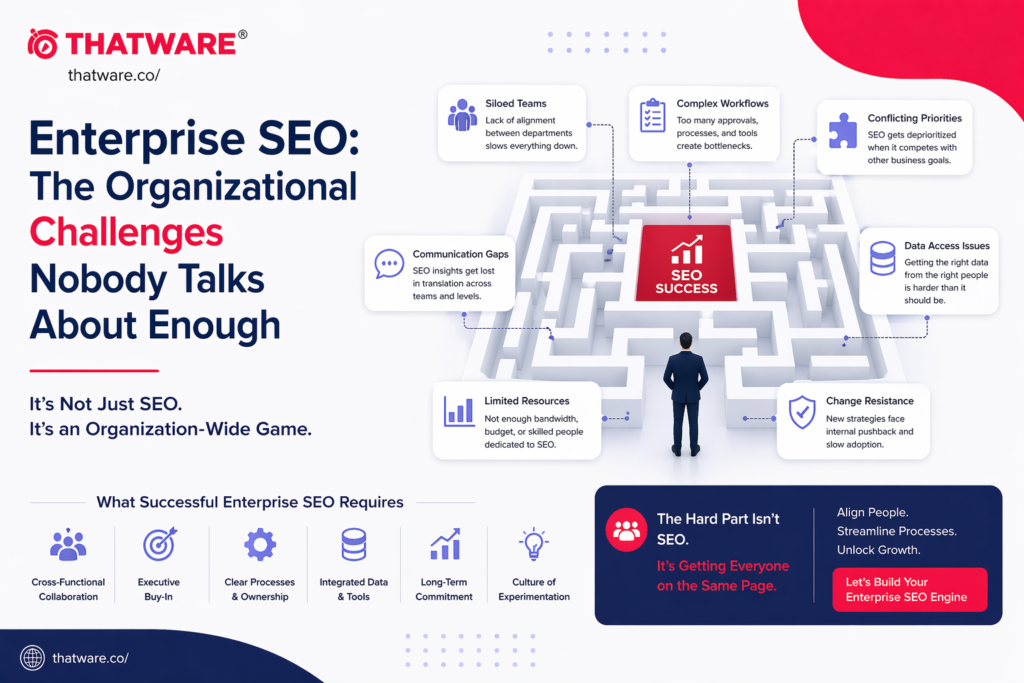
Everyone in enterprise SEO loves to talk about technical strategy. Crawl budgets, international hreflang, JavaScript rendering, Core Web Vitals at scale – these are genuinely complex problems, and solving them well matters. But if you’ve spent time doing SEO inside or for a large organization, you know that technical complexity is rarely the actual bottleneck.
The real bottleneck, almost always, is organizational.
Getting a Fortune 500 company to move quickly on SEO recommendations is a fundamentally different challenge than executing the recommendations themselves. And it’s the challenge that most SEO agency pitches gloss over, even though it’s where most enterprise SEO initiatives succeed or fail.
The Internal Friction Nobody Prepares You For
Large organizations have legal review processes that can hold up content for weeks. They have brand teams that need to approve copy. Engineering queues where SEO fixes sit waiting for sprint prioritization. Multiple stakeholders with competing definitions of what success looks like. Country-specific teams that don’t feel bound by global SEO guidelines. IT departments that control website infrastructure and have never heard of Core Web Vitals.
None of this is unique to any particular company. It’s just what large, complex organizations are like. And it means that the gap between an SEO recommendation being made and it actually being implemented can be months – sometimes longer.
In that environment, technical excellence is necessary but not sufficient. You also need a strategy for navigating the organization itself: building the right stakeholder relationships, framing SEO in terms that resonate with different internal audiences, knowing which battles are worth fighting and which are better worked around.
This is a skill set that genuinely excellent enterprise seo company partners bring – not just technical knowledge, but organizational fluency. The ability to get things done inside complex bureaucracies without burning bridges or losing momentum.
The Prioritization Problem
In enterprise SEO, there are almost always more opportunities than there are resources to pursue them. A large site can have thousands of pages with optimization opportunities, hundreds of content gaps, dozens of technical issues in various states of severity – all competing for attention from teams that have many other priorities.
How you prioritize in this environment is one of the most important strategic decisions in enterprise SEO, and it’s one the industry doesn’t discuss nearly enough.
The mistake most teams make is optimizing for impact without accounting for effort. A recommendation that would drive significant organic traffic but requires a platform rebuild to implement isn’t actually the best place to start. Quick wins that demonstrate value – even modest improvements that can be executed in days rather than months – are often more valuable early on because they build the internal credibility and buy-in needed to tackle larger initiatives later.
This doesn’t mean ignoring high-impact, high-effort items. It means sequencing deliberately: build momentum with what’s achievable now, use that momentum to unlock resources for the bigger lifts.
The Content Complexity at Scale
Large organizations usually have content sprawl. Thousands of pages, many of them outdated, redundant, or competing with each other for the same queries. Consolidated brands with overlapping URL structures. Legacy content from acquisitions that hasn’t been properly integrated. Regional variations that create international SEO complexity.
Auditing and rationalizing that content landscape is genuinely hard work. It requires both technical analysis – understanding what exists, what’s performing, what’s cannibalizing what – and editorial judgment about what should be updated, what should be consolidated, and what should simply be removed.
Advanced seo services that handle enterprise content work well understand that content decisions at scale have organizational implications. Recommending that a company delete 30% of its pages isn’t just a technical call – it involves navigating ownership disputes, protecting relationships with the teams who created that content, and communicating the rationale clearly to stakeholders who may not understand why less content can mean better performance.
Measurement Challenges That Nobody Warns You About
Enterprise SEO measurement is complicated in ways that smaller-scale SEO isn’t. Large organizations often have multiple analytics implementations, inconsistent tagging, data sampling issues, and attribution models that don’t cleanly credit organic search.
Before you can meaningfully measure SEO performance, you often have to solve a data infrastructure problem first. That’s not glamorous work, but it’s essential – and it’s a prerequisite for making confident decisions about where to invest and what’s working.
Reporting in enterprise environments also requires careful translation. The SEO team cares about rankings, traffic, and technical health metrics. The CMO cares about revenue attribution and competitive positioning. The CFO cares about ROI relative to paid channels. Building reporting that serves all these audiences without losing the nuance that matters for day-to-day execution is a meaningful skill.
What Separates Good Enterprise SEO Partners From Bad Ones
The agencies that struggle with enterprise clients tend to bring a playbook built for smaller, more agile companies and try to apply it at scale. They move too fast, underestimate organizational complexity, get frustrated when recommendations don’t get implemented, and eventually both parties feel like the engagement isn’t working.
The agencies that do well have usually internalized a few principles. First: change management is part of the job. Getting alignment across stakeholders isn’t a distraction from SEO work – it’s load-bearing. Second: perfect is the enemy of good. An 80% implementation of a solid recommendation beats a 0% implementation of a perfect one. Third: the relationship is the strategy. Enterprise engagements that work are genuine partnerships, with deep mutual understanding, not just client-vendor transactions.
Those principles are easy to say. They’re hard to consistently execute over a multi-year engagement with a complex organization. The agencies that do are valuable partners. The rest are just vendors.
If you’re evaluating enterprise SEO support, ask how they’ve navigated organizational resistance in past engagements. How they’ve handled a situation where a recommendation sat unimplemented for six months. What their process looks like for aligning stakeholders across departments. The answers will tell you a lot about whether they’re actually equipped for the environment they’re about to enter.