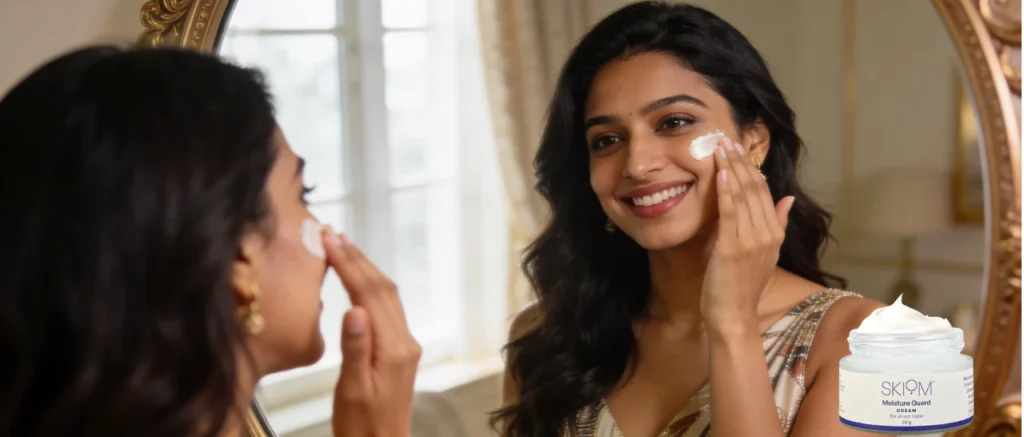
There’s a certain comfort in standing in front of a mirror and trusting your own eyes. You notice a dry patch, maybe a sudden breakout, or that dullness that creeps in after a long week. For years, skincare decisions were mostly intuition, a bit of advice from friends, and trial-and-error products that either worked like magic or just… didn’t.
Now, AI has stepped into that personal space in a way that feels both impressive and slightly unsettling. Skin analysis apps promise to read your face better than you can. But the real question quietly floating around is—how accurate are they, really?
The promise of a “smart mirror” in your pocket
AI-based skincare tools usually work in a simple way. You upload a selfie, and the app scans your skin for concerns like acne, wrinkles, redness, hydration levels, and even pigmentation. Within seconds, you get a breakdown that looks surprisingly clinical.
Related storyThe Skin’s Quiet Ecosystem: Why Microbiome-Friendly Beauty Is Changing Skincare Conversations
For many users, this feels like having a dermatologist in your pocket. No appointments, no waiting rooms, just instant feedback. It sounds almost too convenient—and in some ways, it is.
But convenience doesn’t always equal precision. And that’s where things get interesting.
When algorithms meet real human skin
Skin is messy. It changes with weather, stress, hormones, sleep, diet… even lighting in your room can alter how it looks on camera. AI, on the other hand, prefers consistency and controlled conditions.
Related storyBreathing Cleaner in a Dirty City: How Scalp Care Became Part of Urban Wellness
This gap is exactly where debates around Accuracy of AI-based skin analysis apps in personal skincare begin to surface. These systems are trained on large datasets, which means they can recognize patterns—yes—but they don’t fully understand individuality the way a trained dermatologist does.
For example, a faint redness might be flagged as irritation by an app, while in reality it could just be your natural undertone or a reaction to lighting. Similarly, some apps tend to over-detect “wrinkles” simply because of facial expressions captured in a selfie.
It’s not that the technology is useless. It’s that it’s still learning what human skin actually looks like in all its unpredictable variations.
Helpful tool or overconfident advisor?
Despite limitations, these apps do have a practical role. Many users find them helpful for tracking changes over time rather than relying on a single scan. If your skin consistently shows more oiliness over weeks, or if breakouts are increasing, AI can help you notice patterns you might otherwise ignore.
But there’s a subtle risk here too. Some users start trusting app feedback more than their own experience. If an app says your skin is “aged” or “dehydrated,” it can influence product buying decisions immediately—even if your skin feels perfectly fine.
This is where balance becomes important. AI should guide, not dictate.
Where AI actually performs well (and where it struggles)
To be fair, AI systems are getting better. High-resolution imaging, better training data, and improved facial mapping techniques have made modern skincare apps far more reliable than early versions.
They perform fairly well in detecting visible acne, pore size, and general texture changes. These are easier to quantify.
But subtle conditions—like sensitivity, early inflammation, or hormonal skin shifts—are still difficult for algorithms to interpret accurately. Human dermatologists rely on touch, conversation, and medical history. AI relies only on pixels.
That’s a big difference.
And this is why discussions around Accuracy of AI-based skin analysis apps in personal skincare are still evolving rather than settled. The technology is promising, but not absolute.
The psychology behind trusting an app
There’s also a human side to this story that often gets overlooked. When an app gives us feedback, it feels objective—even when it might not be fully accurate. Numbers and scores create a sense of authority.
If your skin is rated “85% healthy,” you feel reassured. If it drops to “72%,” suddenly you start questioning your entire skincare routine. That emotional influence is powerful, sometimes more than the actual data itself.
It’s a quiet shift: skincare is no longer just personal observation, but algorithmic interpretation.
A future of collaboration, not replacement
The most realistic future of AI in skincare probably isn’t replacement—it’s collaboration. Dermatologists using AI tools for faster analysis. Users tracking long-term changes more effectively. Brands improving formulations based on aggregated skin data trends.
In that sense, AI becomes less of an “expert voice” and more of an assistant. A very fast, pattern-spotting assistant, but still not one that fully understands the nuance of human skin.
And maybe that’s okay.
Because skincare, at its core, has always been part science and part personal relationship with your own reflection. No algorithm can fully replace that quiet moment of self-awareness in front of the mirror.
Final thoughts
AI skincare apps are not gimmicks anymore—they’re evolving tools that genuinely help people become more aware of their skin. But they’re still imperfect, and pretending otherwise does more harm than good.
The smartest approach is simple: use them, learn from them, but don’t surrender your judgment to them completely. Your skin is lived-in, dynamic, and personal in ways no dataset can fully capture.
And until technology catches up with that complexity, a bit of human intuition will always remain part of the skincare equation.